Diesel Fuel Prices Today: September 22, 2026—Costs, Causes and Outlook

U.S. diesel is near $6.53 per gallon. What global supply disruptions, refinery constraints and the fuel outlook mean for truck drivers.
Diesel fuel costs about $6.53 per gallon nationally today, September 22, 2026. AAA reports a daily U.S. diesel average of $6.5276, compared with $6.2694 a week ago and $5.5947 a month ago. That is roughly 26 cents more than last week and 93 cents more than last month. Actual truck-stop prices vary by location and purchase arrangement. Source: AAA daily fuel prices, September 22.
Highway Miles does not provide fuel pricing data. The prices discussed in this article come from the external sources cited.
For truck drivers and owner-operators, the immediate issue is how quickly a higher fuel bill can consume the revenue from a load. This update explains the price trend, the global events behind it, what trucking-industry reporting says about margins, and what the fuel outlook means for the next trip and the years ahead.
Today's diesel prices: the daily average and weekly benchmark
EIA's September 22 release puts the U.S. on-highway diesel average at $6.529 per gallon for its September 21 survey, including taxes. It rose 24.4 cents in a week and is $2.780 above a year earlier. AAA's daily series and EIA's weekly survey are separate benchmarks; neither is a quote for every station.
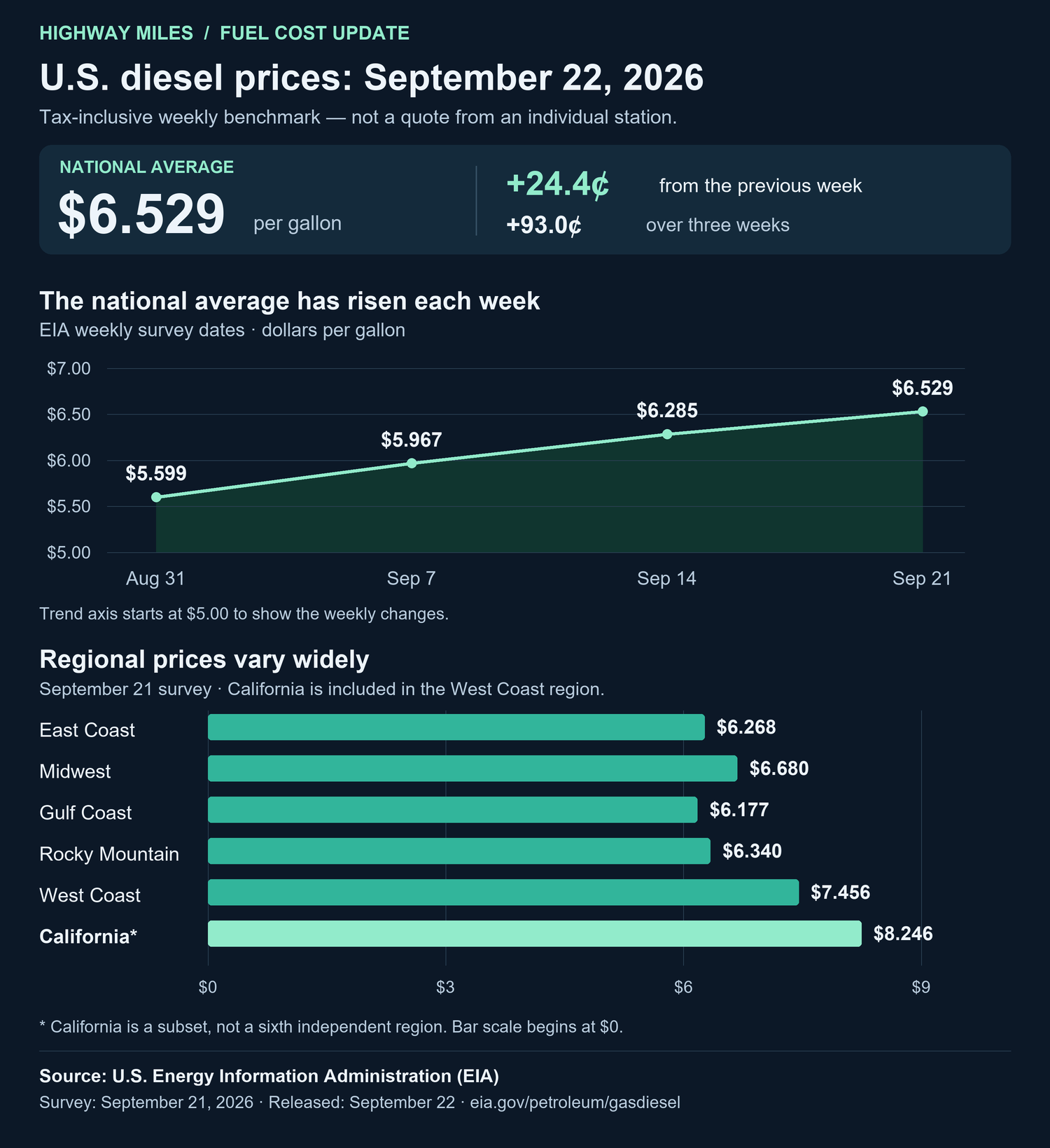
View the diesel price chart full size. Data: EIA. Chart prepared by Highway Miles.
The EIA national trend moved from $5.599 on August 31 to $5.967 on September 7, $6.285 on September 14 and $6.529 on September 21. That is a 93-cent increase, or about 16.6%, in three weeks.
Regional September 21 averages were Gulf Coast $6.177; East Coast $6.268; Rocky Mountains $6.340; Midwest $6.680; and West Coast $7.456. California, which is included in the West Coast figure, averaged $8.246. These regional differences make the route and purchase location important to a fuel budget. EIA regional prices.
What $6.53 diesel means for a truck's fuel bill
Using EIA's unrounded $6.529 benchmark, a 150-gallon purchase costs $979.35. The weekly increase alone adds $36.60 to that purchase.
For a truck driving 2,500 total miles at 6.5 mpg, the same benchmark produces about $2,511 in road-fuel expense, approximately $94 more than at the prior week's price. This is an illustration, calculated as miles divided by mpg, multiplied by dollars per gallon—not a fleet average. Use all driven miles, including empty miles, and your actual fuel economy. Add separate reefer, idling or PTO consumption when it is not already captured in your figures.
The useful planning number is fuel cost per driven mile = price per gallon ÷ actual mpg. At $6.529 and 6.5 mpg, road fuel alone is about $1.00 per mile under those assumptions. That calculation gives a driver a concrete number to compare with the compensation on a load.
Why diesel prices are rising: crude, refineries and global trade
Middle East and Russian supply disruptions are reducing available diesel
The International Energy Agency's September 11 Oil Market Report estimates that combined Gulf and Russian net diesel/gasoil exports in August were 1.6 million barrels per day below February. It identifies severely constrained shipping through the Strait of Hormuz and disruption to Russian refining following Ukrainian attacks. That is an August estimate, not a live measurement of today's shipping.
Reuters reported September 21 that Russia's diesel export ban and refinery damage had pushed buyers such as Turkey and Brazil to seek other supplies. It also described pressure on Red Sea fuel shipments. Because buyers compete in an international market for finished fuel, disruptions abroad can affect the price paid by an American trucker.
More crude oil does not instantly become more diesel
Refineries must turn crude into usable fuel, and available processing capacity matters. The same Reuters report describes refineries elsewhere working hard to replace lost production. It also notes a recovery in China's diesel exports in August—a potential source of relief, rather than proof that the global shortage is over.
The practical distinction is between crude-oil supply and finished-diesel supply. A favorable crude headline can help the outlook while damaged refineries, shipping constraints and delivery costs continue to hold up diesel prices. A one-day oil-price decline therefore does not establish a matching reduction at truck-stop pumps. This is our interpretation of the supply constraints described by IEA and Reuters.
Low stocks and seasonal demand leave less room for disruption
EIA's September outlook forecasts U.S. distillate inventories below 100 million barrels in September and below the 2021–2025 seasonal low through much of 2027. Its analysis identifies strong exports, reduced international production, autumn refinery maintenance, harvest activity and winter heating demand as pressures on the market. Distillates include diesel and heating fuels. Source: September 2026 Short-Term Energy Outlook.
That combination helps explain why prices can react sharply to another outage. It does not establish that every truck stop will run out of fuel. Pricing pressure, low national inventories and a local station outage are different claims.
What trucking-industry news says about rates and margins
FreightWaves' September 19 analysis explains a problem for fleets purchasing fuel at wholesale-linked prices: their costs can rise before a retail-indexed surcharge catches up. Smaller carriers purchasing at retail may instead struggle to negotiate enough additional spot revenue. A surcharge is useful, but its existence alone does not prove full cost recovery.
The Trucker's September 21 DAT recap makes another important distinction: all-in dry-van and flatbed rates rose in its reporting week while the underlying linehaul rates fell. Higher gross revenue can therefore conceal a weaker result after fuel. That report covers September 13–19 freight and uses an earlier diesel observation in its surcharge calculation; it is not today's pump-price report.
Overdrive's September 16 report, updated September 20, shows why owner-operators translate a fuel-price change into cents per mile before discussing a rate. The amount depends on the truck's mpg and the miles involved. For example, this week's 24.4-cent benchmark increase equals about 4.1 cents per driven mile at 6 mpg—our calculation, not a promised rate increase.
Drivers should check the agreement's benchmark date, reset schedule, assumed mpg, eligible miles and payment timing. Whether empty miles or other fuel use is compensated depends on the agreement. Recovering an expense later also does not eliminate the cash needed to buy fuel today. Tank Transport's September 21 analysis explains the distinction between surcharge timing and cash collection.
Will diesel prices come down? What drivers can expect
The sources reviewed do not establish a guaranteed date for relief. In a Reuters report dated September 21 and updated September 22, storage-market participants described conditions consistent with tight supply into at least early 2027. That is an attributed market outlook, not a certainty or a prediction of nationwide pump closures.
EIA's September outlook projects a $4.40-per-gallon U.S. retail diesel average for calendar 2027, conditional on improving supply. Its model inputs were finalized September 3, before the latest developments. The number is an annual average, not a next-week price, a year-end target or a guaranteed return to cheaper fuel. Read the dated EIA forecast.
For near-term planning, our reading of those sources is to keep three possibilities in view:
Gradual relief: sustained improvements in shipping and refinery output allow inventories to rebuild. A lower crude price alone is insufficient evidence.
Continued pressure: supply improves slowly while seasonal demand and maintenance keep the market tight.
Another jump: renewed infrastructure or shipping disruptions remove more supply from an already strained market.
These are planning scenarios, not probability-weighted forecasts. Watch weekly diesel benchmarks, actual prices on your lanes, refinery recovery and shipping conditions. Budget upcoming loads from current costs rather than assuming a forecast decline has already arrived.
The future of truck fuel: more options, different operating requirements
Renewable diesel and biodiesel
DOE's Alternative Fuels Data Center describes renewable diesel as a hydrocarbon fuel meeting ASTM D975, the U.S. petroleum-diesel specification. It can use existing diesel engines and infrastructure. Where suppliers offer it, that makes it an option without replacing the truck; it does not guarantee a cheaper gallon or universal availability.
Biodiesel is a different fuel, commonly sold in blends such as B20—20% biodiesel. Check the engine manufacturer's approved blend, warranty conditions and cold-weather guidance. Renewable diesel and biodiesel should not be treated as interchangeable labels.
Battery-electric trucks
DOE's fleet guidance identifies shorter, predictable routes with a return to base as useful early applications. A workable plan must account for range under load, charging time, electrical capacity, energy charges and vehicle support. Our operational takeaway: evaluate the complete route and charging plan; a passenger-car charging location does not establish suitable truck access.
Hydrogen fuel-cell trucks
DOE's hydrogen-station guidance explains that heavy trucks require much greater station capacity than light-duty vehicles. Reliable fuel supply and truck-compatible infrastructure remain key considerations. Hydrogen's potential for trucking does not make every public hydrogen station usable on a commercial route.
The transition will vary by equipment and route. Alternative fuels and powertrains offer options, but none supplies a guaranteed immediate escape from this week's operating costs.
Five practical steps before accepting the next load
Update the fuel calculation. Use current purchase prices, actual mpg and all driven miles. Separate any additional reefer or stationary consumption.
Check what the rate includes. Compare linehaul, surcharge, covered miles and payment timing with the trip's costs.
Plan fuel stops along the truck route. Compare the total detour, time and fuel consumed with the apparent pump-price saving.
Review avoidable miles and idling. Confirm appointments, entrances and stops in advance; use safe, equipment-appropriate operating practices.
Keep a workable backup stop. Verify access and availability with the operator when necessary, and avoid relying on one location with little reserve.
Highway Miles' truck route planner can help organize fuel and service stops alongside the rest of the trip. Check current pump prices directly with the truck-stop operator or your fuel provider. Our fuel-stop detour guide explains how to compare a lower pump price with the miles required to reach it. Better planning cannot control global fuel prices, but it gives drivers a clearer view of the costs they can manage.
Prices and reporting checked September 22, 2026. All prices are U.S. dollars per U.S. gallon unless stated otherwise. This is a dated market update; linked live price pages will change. Forecasts and illustrative calculations are identified separately from observed prices.